
How to Look Up Manatee County Jail Population Data
The Sheriff's site collects the official Manatee County source data. The Media and Publications navigation on manateesheriff.com links to Budget Documents, Crime Statistics, Audit Reports, Annual Goals & Objectives, and PREA Reports & Statistics. Those reports are the right place for the most current capacity, average daily population, and any local 5-year trend.
For broader context, the federal Bureau of Justice Statistics publishes the Jail Inmates report series at bjs.ojp.gov. The Vera Institute Incarceration Trends project at incarcerationtrends.vera.org publishes county-level jail data including Manatee. Prison Policy Initiative at prisonpolicy.org publishes Florida data summaries used by researchers and reporters.
The Bureau of Justice Statistics homepage organizes the national jail data series by topic.
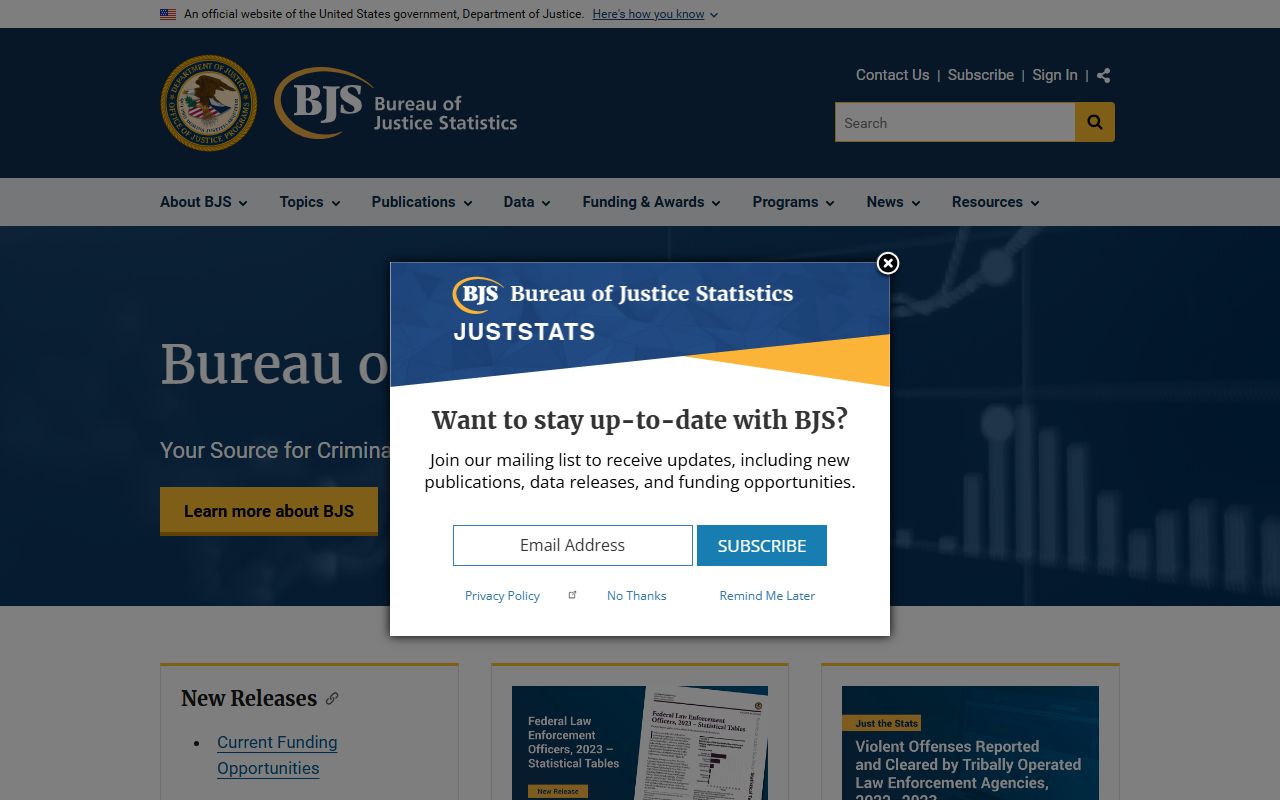
BJS data is the anchor for comparing Manatee County to Florida and to the national jail population.
Manatee County Jail Capacity Overview
The Manatee County Central Jail is the single adult intake and housing facility in the county. The Sheriff's Office runs the jail under its Corrections Bureau. The official jail pages reviewed do not publish a static capacity number for the public page. The Sheriff's annual budget and PREA reports are the right source for that number when it is needed for a specific year.
| Facility | Address | Phone | Notes |
|---|---|---|---|
| Manatee County Central Jail | 14470 Harlee Road, Palmetto, FL 34221 | (941) 747-3011 main; (941) 723-5132 booking/bond | Central booking and adult jail; intake includes property, medical, fingerprints, photograph, warrant check. |
| Visitation Center | 2705 County Line Road, Palmetto, FL 34221 | (941) 747-3011 ext. 2902 | Non-contact video visitation and cash kiosk; no housing. |
Average Daily Population at the Manatee County Jail
Average daily population, often abbreviated ADP, is the standard measure of jail use. It is the sum of the daily population counts over a year divided by 365. ADP smooths out one-night spikes and gives a stable view of how many people the jail is holding. The Sheriff's budget documents and annual reports publish ADP figures when produced.
ADP can move quickly when policing patterns change, when local prosecutors shift charging practices, or when a court ruling changes pretrial detention. ADP also moves when the local economy or population changes. The Manatee County population has grown significantly in recent decades, which is one factor in any longer-term comparison.
Demographic Breakdown
Florida sheriffs report jail demographic data to the Florida Model Jail Standards program and to BJS. The categories typically include sex, race, age range, and offense class. A demographic snapshot for any single day gives a useful picture. A year-long ADP by category shows whether the share is stable or changing.
The Sheriff's PREA reports also include data about the inmate population because PREA reporting requires the agency to identify housing and incident patterns. Those reports are the right source for the most recent local demographic share.
Pretrial vs Sentenced Manatee Jail Population
Like most U.S. county jails, the Manatee County jail holds two main groups. The first group is pretrial detainees: people who have not yet had a trial or accepted a plea and who could not post bond. The second group is sentenced inmates: people serving a county sentence after a misdemeanor or low-level felony judgment. A smaller share of the population is held on warrants from other agencies or pending transfer to a state or federal facility.
| Group | Description |
|---|---|
| Pretrial | Awaiting first appearance, bond, plea, or trial. |
| Sentenced | Serving a county sentence after conviction or plea. |
| Holds / Transfers | Other-agency warrants or transit to state / federal custody. |
| Specialty Court | Participants in Comprehensive Treatment Court, Health Care Court, or Veterans Treatment Court who are still in custody. |
Misdemeanor vs Felony Population
Misdemeanors are County Court matters punishable by up to one year in county jail. Felonies are Circuit Court matters that can carry state prison time. Many people in the Manatee County Central Jail are held on a mix of misdemeanor and felony charges. Some are held on a single misdemeanor with low bond. Some are held on a serious felony with no bond.
The Sheriff's data captures the most serious charge per inmate. That single charge does not always show the full criminal history or open cases. The Clerk's court records show every active case for a person, which is why a complete picture sometimes needs both files.
Mental Health and Medical Population
The Sheriff's intake includes a medical screening, which captures mental-health and medical needs at booking. The Twelfth Judicial Circuit's Comprehensive Treatment Court and Health Care Court serve eligible inmates whose mental illness is tied to a qualifying offense in Manatee County. Participation is voluntary and requires defense, prosecutor, and judicial approval.
Mental-health clinical records are confidential under Fla. Stat. § 394.4615. The Sheriff and Clerk do not publish individual diagnoses or treatment plans. Aggregate counts may appear in Sheriff reports for accreditation and PREA purposes.
National and Florida Context
The Bureau of Justice Statistics Jail Inmates report series tracks national jail population, admissions, and trends. The series provides per-100,000 rates that let a reader compare Manatee County to Florida and to the United States. Vera Institute and Prison Policy Initiative both publish derived rates for Florida counties using BJS data.
| Source | What It Covers |
|---|---|
| BJS Jail Inmates report | National and state jail counts; demographic detail; trend lines. |
| Vera Incarceration Trends | County-level jail and prison rates per 100,000 residents. |
| Prison Policy Initiative | Florida overview tables and policy briefs. |
| Sheriff Annual Goals & Objectives | Local capacity, ADP context, accreditation status. |
| Sheriff PREA Reports & Statistics | Required PREA disclosures and housing breakdowns. |
Population Trends Over Time
Manatee County's population has grown sharply in the past two decades, especially in east-county neighborhoods served by Lakewood Ranch and Parrish. A growing residential base, more law enforcement officers, and more activity on State Road 64 and US-301 corridors all feed into more booking events. The state's pretrial reform debate and Florida's sentencing changes have moved the pretrial share up and down. Hurricane and storm closures, like Hurricane Milton and Tropical Storm Debby/Helene noted in the Sheriff's official news, also affect operations.
A reader looking for a clean trend line should use BJS data for Manatee, Vera Institute county pages, and the Sheriff's annual reports. National policy changes and local elected-official decisions can both shift the curve.
Searching for Manatee County Inmate Records by Name
This page focuses on jail population data, not individual-inmate lookups. To search for one person, use the Manatee County inmate records page. That page covers the Sheriff's Arrest Inquiry app, the 90-day release window, intake steps, bond rules, and visitation. The released inmates page covers people who left custody in the last 90 days.
Where the Manatee Jail Population Data Comes From
Local data is produced by the Manatee County Sheriff's Office and published through the Sheriff's website and annual reports. State data is reported to the Florida Model Jail Standards program and to FDLE. Federal context comes from BJS. None of those sources will give a real-time minute-by-minute count, but each one is reliable for the period it covers.
Note: Treat any number on a third-party site as out of date until you can match it to a current Sheriff report, a BJS table, or a Vera county page.
Manatee County Jail Accreditation
The Sheriff's official news list notes the 2024 MCSO Corrections Bureau re-accreditation by the Florida Corrections Accreditation Commission. Accreditation requires the jail to meet a long set of standards covering intake, classification, housing, medical care, food service, recreation, and use of force. Accreditation results affect funding, insurance, and inmate-welfare programs. Re-accreditation is a routine sign that the jail's documented policies and practices line up with statewide standards.
The Sheriff's PREA reports also describe how the jail tracks and reports incidents under the federal Prison Rape Elimination Act. PREA reporting is independent of accreditation but adds another data source about the population, housing patterns, and incident counts.