
How to Search Manatee County Criminal Records
The fastest free path is the Clerk's Court Records person search. Type a last name, optionally a first name, and pick a case type if you want to limit results. Felony cases show up under case type Felony with the CF code. Misdemeanors show up under Misdemeanor with the MM code. Criminal Traffic, Search Warrant, and Extradition are separate case types.
For the booking side of a case, use the Sheriff's Arrest Inquiry app. It shows current jail population and releases from the last ninety days. For a statewide criminal history, contact the Florida Department of Law Enforcement.
- Open the Clerk Court Records person search.
- Enter the last name and optional first name.
- Pick Felony, Misdemeanor, or Criminal Traffic from the Case Type list.
- Submit and review the case status and file date columns.
- Click View on a case to open the docket and read charges, plea, and disposition.
- Cross-check with the Sheriff's Arrest Inquiry app for booking and release info.
- Order a certified copy from the Clerk if you need the file for legal use.
Felony and Misdemeanor Case Types
The Manatee County Clerk splits criminal records by tier. Felony cases sit in the Circuit Court under three felony divisions. Misdemeanor cases sit in the County Court. Criminal traffic, which can include some DUI and license offenses, is its own case type. Misdemeanors carry penalties up to one year in county jail. Felonies can carry state prison, probation, and in capital cases the death penalty.
| Case Type | Court | Common Offenses |
|---|---|---|
| Felony (CF) | Circuit Court | Burglary, grand theft, sale of controlled substance, robbery, homicide |
| Misdemeanor (MM) | County Court | Petit theft, simple battery, disorderly conduct, trespass |
| Criminal Traffic | County or Circuit Court | DUI, driving while license suspended, leaving the scene |
| County Ordinance Arrest | County Court | Local ordinance violations resulting in arrest |
| Municipal Ordinance Arrest | County Court | City ordinance violations from Bradenton, Palmetto, Holmes Beach, others |
| Search Warrant | Circuit or County Court | Court-authorized searches; many filings sealed |
| Extradition | Circuit Court | Out-of-county or out-of-state warrant transfers |
Arrest Inquiry vs Manatee County Criminal Case
A booking is not the same thing as a criminal case file. The Sheriff's Arrest Inquiry app shows who is in custody right now and who was released in the past 90 days. The official page disclaimer warns that this online information does not detail the final disposition of criminal justice proceedings and that all arrestees are innocent until proven guilty.
To learn what happened after the arrest, look at the Clerk's Court Records search. The court file lists every event from first appearance to sentencing. Statewide criminal history information lives at FDLE. The Manatee County Clerk says it cannot run a statewide background check; the Clerk handles only Manatee County court records.
The Sheriff's Arrest Inquiry page hosts the booking-search application and the public-record disclaimer.
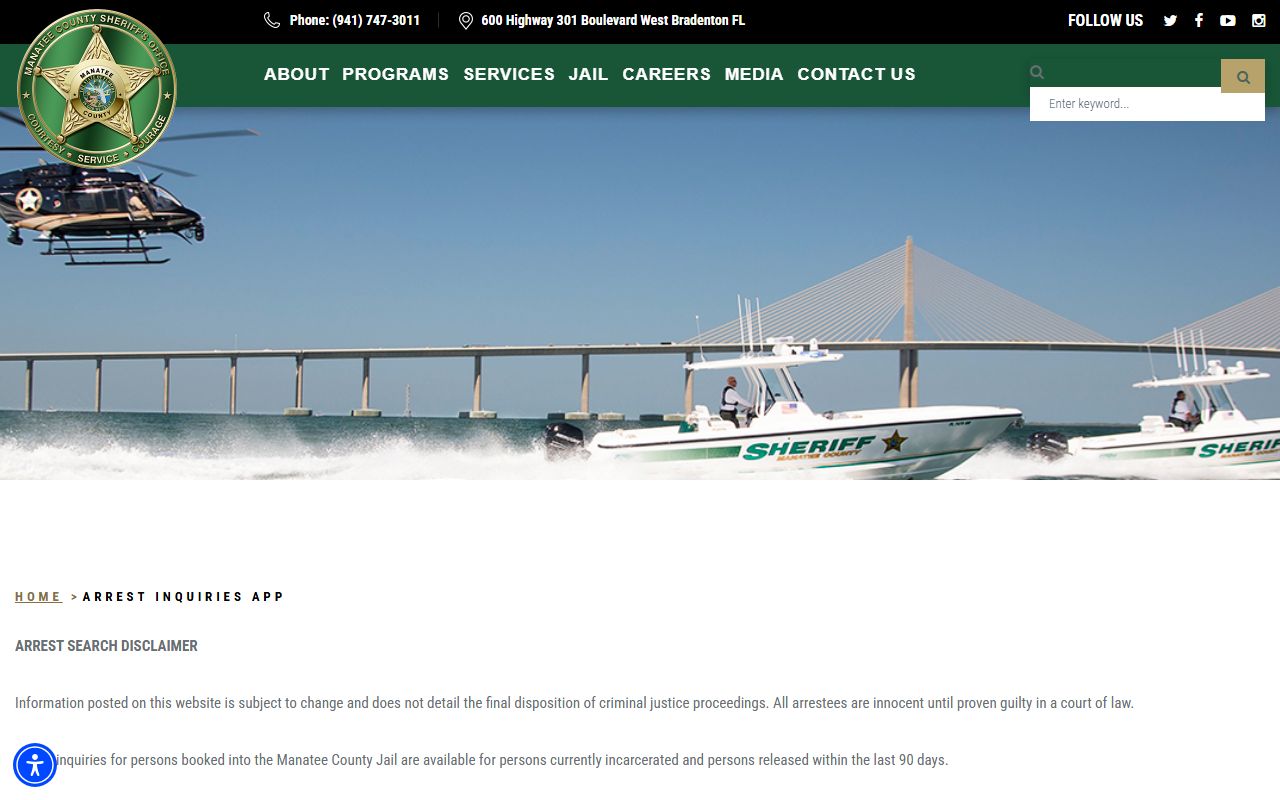
The disclaimer warns that the data is not a final disposition and that all arrestees are presumed innocent until proven guilty.
| Charges Filed | Conviction |
|---|---|
| Filed by the State Attorney based on an arrest or grand jury action. | Result of a guilty plea, no-contest plea with adjudication, or jury verdict. |
| Listed in the booking record and in the charging document. | Entered as a judgment by a Circuit or County Court judge. |
| Does not prove guilt; presumption of innocence applies. | Triggers points, sentence, and consequences under Florida law. |
| Can be dropped, reduced, or upgraded before trial. | Becomes part of the public criminal history at FDLE. |
First Appearance and Bond in Manatee County
The Sheriff's Jail Information page says all arrestees who do not bond out routinely appear before a judge within 24 hours after arrest. The judge informs the defendant of the charges and, where appropriate, sets bond. For misdemeanors, the judge may accept a guilty plea and release on recognizance or time served. For felonies, the judge may raise, lower, or maintain bond. Some defendants are referred for Supervised ROR screening, which can lengthen processing.
The jail receives first appearance results from the Clerk around 11:30 a.m. each day. Families and bondsmen calling earlier are told to wait until the results arrive. Charges and bond after booking are also available through the Charges & Bond page, by phone at (941) 723-5132, or in person at the Central Jail front desk at 14470 Harlee Road, Palmetto.
Final Disposition from the Manatee County Clerk
A booking shows the arrest. The court file shows the result. The Clerk's portal is the right tool for final disposition, sentence, fine, and probation status. Use the case number from the booking sheet if you have it. If not, use the Person search with the defendant's name and the Felony or Misdemeanor case type.
Status codes vary. OPEN means the case is active. CLOSED means the case is done. DFR - CLOSED means a defendant failed to appear and the file was closed under a Florida tag. COLLECTIONS-OPEN means a court-ordered judgment or fine is being collected. To read the full event history, click the View icon on the result row and scroll the docket.
Statewide Florida Criminal History
For statewide criminal history, contact FDLE. The Sheriff's Arrest Inquiry page sends users with statewide or sealing questions to FDLE Public Records at (850) 410-8109 and FDLE's website. FDLE produces certified statewide rap sheets and runs the Florida sex offender and predator registry. The Manatee County Clerk cannot run statewide background checks.
For state prisoners, use the Florida Department of Corrections offender search. For federal prisoners, use the Bureau of Prisons inmate locator. For custody-change notifications, register with Florida VINELink.
The FDLE sex offender registry is searchable by name, address, county, or zip.
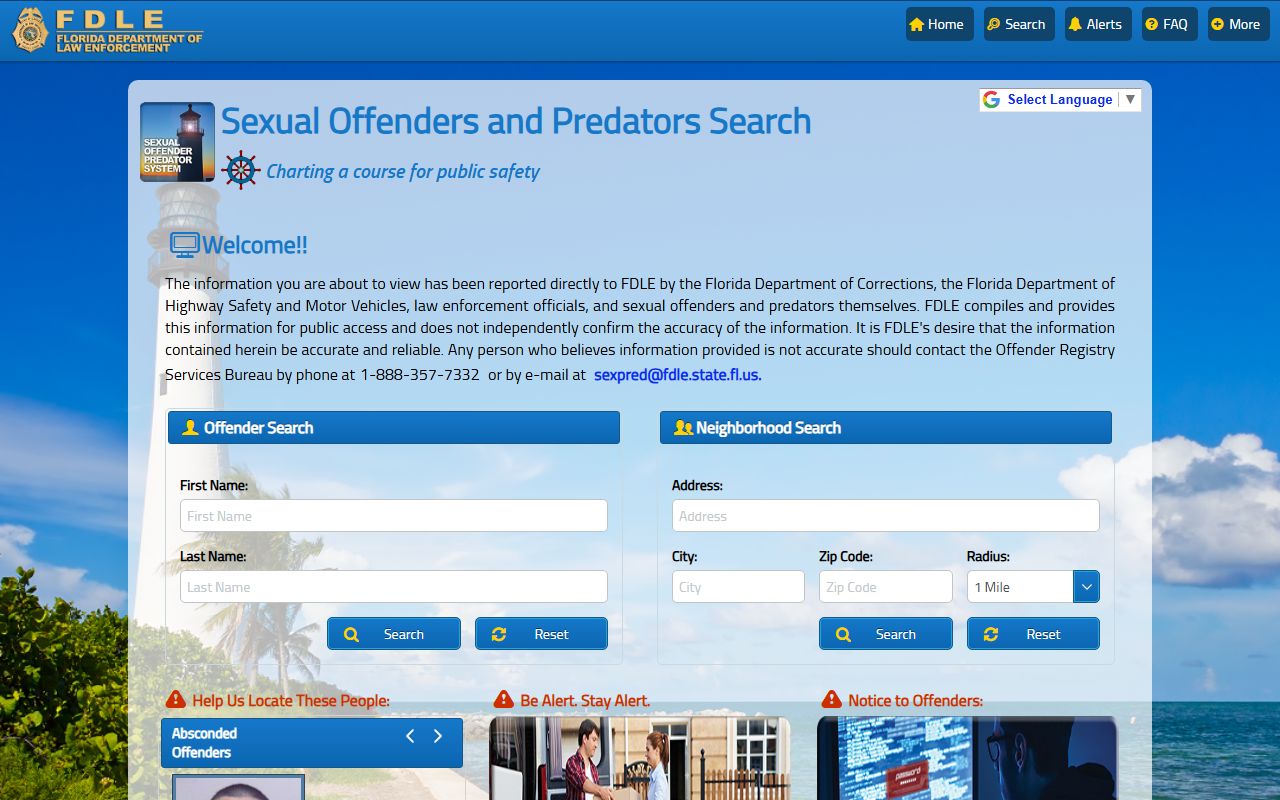
A Manatee County search localizes the result to registered offenders in the county.
Sealing and Expunction in Manatee County
Florida criminal records can be sealed under Fla. Stat. § 943.059 or expunged under Fla. Stat. § 943.0585. Sealing limits public access; expunction destroys most agency copies and lets the person lawfully deny the arrest in many contexts, with statutory exceptions for bar admission, criminal-justice employment, and certain licenses.
The general flow starts with FDLE. The person applies to FDLE for a Certificate of Eligibility. Once FDLE confirms eligibility, the person files a petition in the court that handled the case. In Manatee County that is usually the Twelfth Judicial Circuit. After the court enters the order, the Clerk and criminal-justice agencies put the order into effect.
- Common denials: ineligible offense, prior disqualifying conviction, missing FDLE certificate, incomplete petition, or a disposition that does not meet statutory criteria.
- Sealed cases drop off the Clerk's public search but remain visible to a narrow set of agencies.
- Expunged cases drop further but the law still allows disclosure in specific listed roles.
- Juvenile records have their own confidentiality rules under Fla. Stat. § 985.04.
Warrants, Capias, and Manatee County Criminal Files
Failure to appear in a criminal case usually triggers a capias or a bench warrant. A capias is a Florida arrest order issued by the court. A bench warrant comes from a judge during a hearing. Both show up on the docket as a docket entry and may also appear if the person is later booked into the jail.
If you think a Manatee County warrant might exist, check the Manatee County warrant records page for the steps. Do not rely on third-party warrant lookup sites. The Sheriff's Wanted link to Manatee County Crime Stoppers is the official wanted list referenced from the Sheriff's site.
Manatee County Specialty Criminal Courts
The Twelfth Judicial Circuit runs three problem-solving courts that handle eligible criminal defendants in Manatee County. Comprehensive Treatment Court (Mental Health Court) follows the legislative intent of Fla. Stat. § 394.47892. Health Care Court meets the third Thursday of each month in Courtroom 2A of the Manatee County Judicial Center. Veterans Treatment Court is a voluntary four-phase program for veterans facing criminal charges tied to service-related issues. Judge Stephen M. Walker presides over the Mental Health Court and the Problem Solving Court Division P.
Note: Entry to a Manatee County specialty court is voluntary and requires defense, prosecutor, and judicial approval, so eligible defendants should ask counsel early.